
Value realization software helps B2B companies prove, after the contract is signed, that customers received the value promised in the sale. In 2026 the market splits into six categories: value selling and ROI tools, enterprise value engineering platforms, revenue enablement suites, AI value intelligence tools, customer success platforms, and end-to-end CVM platforms. Most tools cover either the sale or the account, not both. The deciding question is whether the business case from the deal becomes the success plan after it.
In our guide Navigating the Customer Value Management Ecosystem we sorted CVM vendors by approach. This follow-up compares them on the point where most value programs break: the handover from sales to customer success.
That handover is where revenue is won or lost. McKinsey research cited in our ecosystem guide found that tech companies with mature value selling, realization and adoption journeys achieve NRR around 7 percentage points higher than peers with basic practices.
Key takeaways
Value selling tools build the business case. Customer success platforms track the account. Few tools connect the two.
The test for any vendor: does the metric promised in the deal become a tracked metric after go-live, without retyping it?
European companies should check where customer value data is hosted and processed, because it often includes sensitive customer financials.
Software scales a value practice but doesn't create one. Plan the operating model before the tool.
Where does each category of CVM tool stop?
Most CVM tools are built for one side of the signed contract. Value selling tools work before it and customer success platforms work after it. Few categories carry the same value model across the line.
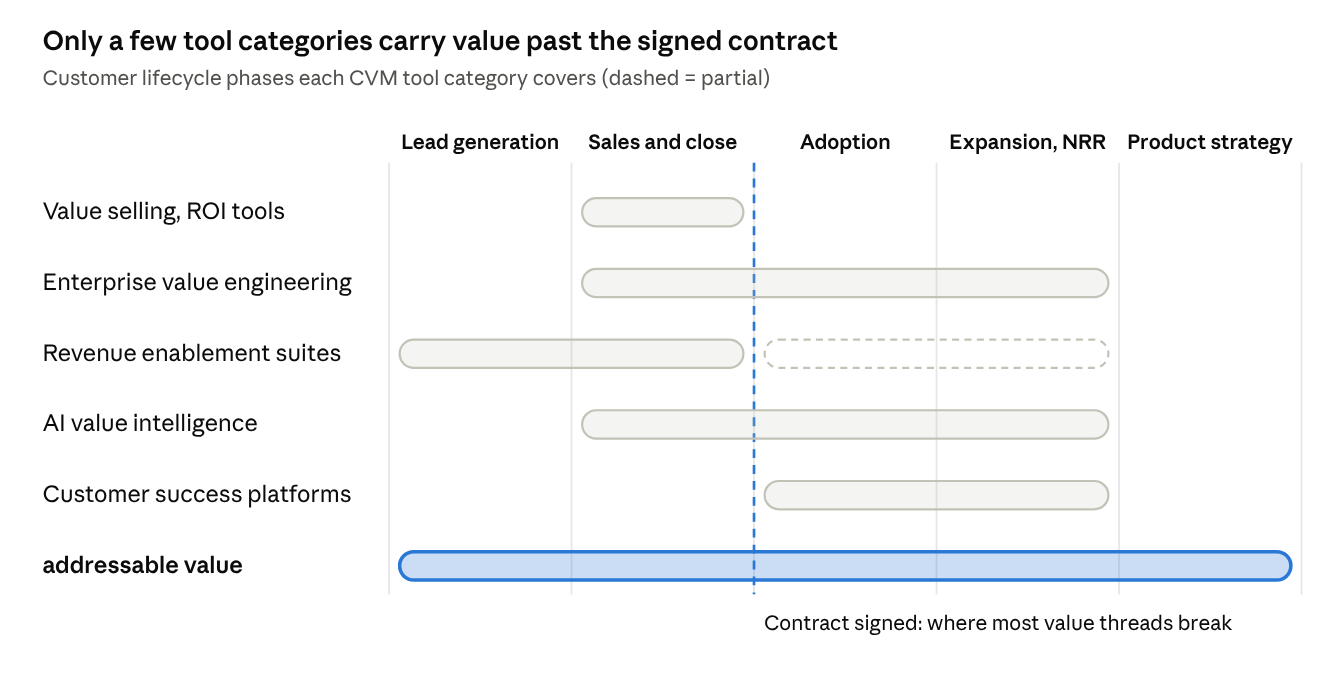
The phases follow the customer journey: lead generation, sales and close, adoption, expansion and NRR, and product strategy, where realized value feeds back into the roadmap. Only end-to-end CVM covers that last phase.
How do value realization tools compare?
The six categories differ mainly in one thing: whether the value promised in the deal is still tracked after the contract is signed. Inside each category the vendors are close to each other. Across categories the differences are large, so choose the category first and the brand second.
| Category | Example vendors | Strongest phase | Business case carried into post-sale? | Best fit | Watch out for |
|---|---|---|---|---|---|
| Value selling and ROI tools | Cuvama, LeveragePoint, ValueCore, Symbe, theROIshop | Discovery and business case | Rarely. The case usually ends at signature. | Sales teams standardizing ROI cases | Metrics from the deal don't reach onboarding or CS |
| Enterprise value engineering platforms | Ecosystems, DecisionLink | Business case through value realization | Yes. DecisionLink has a Value Achievement Tracker, and Ecosystems extends value tracking into CS. | Large enterprises with a dedicated value engineering team | Complexity, and too heavy for everyday AE and CSM use |
| Revenue enablement suites | Mediafly | Content, coaching and the business case | Partly. Value is one module among many. | Teams centralizing sales enablement in one suite | Heavier implementation, and value isn't the core of the suite |
| AI value intelligence tools | Minoa | Automated business cases and renewal scorecards | Yes, with a focus on the GTM pipeline | Software companies whose value motion breaks at field scale | Little link to product strategy. Check where data is hosted. |
| Customer success platforms | Gainsight, Planhat, Vitally, ChurnZero, Totango | Adoption, health and renewals | Not natively. Success plans don't start from the deal's business case. | CS teams that run on health scores and playbooks | Usage and health aren't proof of business outcomes |
| End-to-end CVM platform with methodology | addressable value | All five lifecycle phases, including product feedback | Yes. One value plan from discovery to renewal. | Series A+ B2B SaaS and AI companies scaling their GTM teams | Engagement-led, not self-serve. It starts with a Value Expert building the framework. |
Sources for the vendor descriptions: vendor websites, Minoa's comparison and Raze's value realization roundup. Pricing is left out because most vendors don't publish it.
Which tool fits which situation?
Pick the category by the problem you can name today. Buying for a problem you don't have yet is the most common way these projects stall.
| If your main problem is… | Start with | Why |
|---|---|---|
| Reps can't build a credible ROI case on their own | Value selling and ROI tools | Fastest way to standardize business cases in deals |
| A dedicated value engineering team builds complex cases by hand | Enterprise value engineering platforms | Deep financial modeling for a specialist team |
| CSMs can't tell which accounts are at risk | Customer success platforms | Health scores, playbooks and renewal workflows |
| Renewals are defended with usage stats instead of business outcomes | A tool that carries the business case into post-sale: enterprise VE, AI value intelligence or end-to-end CVM | The promised metrics need to be tracked after go-live |
| Sales and CS each define value differently | End-to-end CVM platform with methodology | Fix the shared Value Framework first, then scale it with software |
| Customer value data must stay in the EU | Vendors with EU hosting and processing, such as addressable value | Value data often includes customer financials and KPIs |
Three questions to ask every vendor:
Show me one account where a metric from the business case is tracked after go-live. Ask for a live example, not slides.
Where is customer value data hosted and processed, including by AI models? Ask for the data processing agreement and the list of sub-processors.
Who maintains the value model after launch? If the answer is "your value engineering team" and you don't have one, plan for that gap.
What does value realization software not solve?
No tool in this comparison fixes a missing definition of customer value. When sales promises one outcome and customer success measures another, software just records the mismatch faster.
Three things have to exist before any value realization tool pays off:
A shared Value Framework. It sets the value themes customers buy for and the value metrics that prove them, and sales, CS and product all agree on it.
A clear owner. A Value Function keeps the framework current and coaches the teams that use it.
A fixed rhythm. The business case is written in the deal, value plans are set at onboarding, and value reviews happen in QBRs and before renewal.
This is why addressable value works engagement-first. A Value Expert works inside the client team to build the Value Framework and embed it in sales and post-sales routines. Then the Customer Value Platform and AI Customer Value Agents scale it. The end state is a Value Practice the client runs on its own, with customer value data hosted in the EU.
For the details of what happens after signature, read Beyond the Signed Contract: Closing the Value Realization Gap.
Frequently asked questions
What is value realization software?
Value realization software tracks whether customers achieve the business outcomes they bought for, and makes that evidence usable in QBRs, renewals and expansion. It differs from ROI calculators, which estimate value before the sale, and from customer success platforms, which track usage and health.
Are there automated platforms that focus on post-sale value realization?
Yes. Enterprise value engineering platforms (Ecosystems, DecisionLink), AI value intelligence tools (Minoa) and end-to-end CVM platforms (addressable value) all carry the business case into post-sale tracking. Value selling and ROI tools mostly stop at the signed contract.
Should we choose a specialized value management platform or a general customer success tool?
The trade-off is depth of value against breadth of CS workflow. A customer success platform covers health scores, playbooks and renewals, but it doesn't start from the business case sold in the deal. A specialized value management platform keeps that business case as the system of record for outcomes. Many teams run both, with value data feeding the CS platform.
Which value realization tools host data in Europe?
Check each vendor's data processing agreement and sub-processor list, including the AI models used. addressable value runs on European hosting and processing for customer value data.
How do you prove customer ROI during renewal negotiations?
Compare the metric promised in the original business case with the value measured since go-live, against the baseline agreed at onboarding. That works only if the baseline was captured. Without one, renewal talks fall back to usage and feature lists.
Can we do value realization with spreadsheets?
For a handful of strategic accounts, yes. Past that, spreadsheets break: baselines get lost at the handover, each CSM tracks different metrics, and there's no portfolio view of promised versus realized value.
